In short: a policy states what the organisation wants and why, a process shows how work flows between people and departments, a procedure (SOP) defines how one process is carried out and by whom, and a work instruction explains one task step by step at the workstation. The four levels answer different questions and are written for different readers. Mixing them up is the main reason documentation is not read.
What are the four levels at a glance?
| Document | Answers | Written for | Typical length | Example |
|---|---|---|---|---|
| Policy | What do we want, and why? | Management, auditors, customers | One page | "All products leave the plant with a documented final inspection." |
| Process | How does work flow from input to output? | Process owners, department heads | One diagram | Order intake → planning → production → final inspection → shipping |
| Procedure (SOP) | Who does what, in which order, under which conditions? | Team leaders, quality staff, operators | One to three pages | "Final inspection of assembled pumps": sampling, checks, release criteria, records |
| Work instruction | How exactly do I perform this task? | The person at the workstation | One screen per task | "Pressure test pump type B": 12 steps with photos, target values and a photo of the result |
What belongs in a policy?
A policy is a short statement of intent approved by management: what the organisation commits to and why. Quality policies, safety policies and data protection policies are the usual examples. A policy contains no steps. Its job is to give every procedure below it a reason to exist and to tell an auditor or customer what the company stands for.
The most common mistake is to write policies that read like procedures. If a policy contains the words "first", "then" and "finally", it belongs one or two levels lower.
What does a process describe?
A process describes how work moves from a trigger to a result across people and departments: order intake, planning, production, inspection, shipping. It is best shown as a diagram with swim lanes rather than as text, because its purpose is to make hand-overs visible. A process does not say how each box is performed; that is what procedures are for.
Processes matter most when something goes wrong between departments. If production complains that planning releases incomplete orders, the fix is at process level, not in a work instruction.
What does a procedure or SOP define?
A standard operating procedure defines how one process or a substantial part of it is carried out: the purpose and scope, who is responsible, which inputs and tools are needed, the sequence of activities, the decision points and the records that must be kept. An SOP is the document that connects the intention of the policy with the actions at the workstation. For a complete definition and a writing guide, see what an SOP is and why it matters.
A good SOP is written for the team leader and the trained operator. It should fit on one to three pages, use numbered activities, name roles instead of people and state clearly where a record is created. What it should not do is describe every hand movement; that level of detail makes the SOP long, hard to maintain and unread.
What does a work instruction do?
A work instruction zooms in on one activity from a procedure and explains it so precisely that a trained colleague can perform it without asking questions: one action per step, a photo or short video of the real situation, target values, tolerances and the check that confirms the step is done correctly. Work instructions live at the workstation, ideally opened through a QR code or NFC tag on the machine.
Because work instructions are so concrete, they change most often: a new fixture, a changed torque, an extra check after a complaint. That is why they benefit most from being digital, with version control, so the operator always works from the current version. The page on digital work instructions shows what that looks like in practice.
How do the levels link together?
The levels form a chain of references. The quality policy says that every product is inspected before release. The production process shows where final inspection sits between assembly and shipping. The SOP "final inspection" defines who inspects, what is sampled, which criteria apply and which record is kept. The work instruction "pressure test pump type B" tells the inspector exactly how to perform one of the checks in that SOP.
When a document references the level above it, three things become easy: an auditor can trace any action back to a policy, a change in a procedure shows which work instructions must be reviewed, and new employees understand why a step exists instead of only how to perform it.
Which document should you write?
| Situation | Write or change |
|---|---|
| Management wants a commitment that customers and auditors can see | Policy |
| Departments disagree about hand-overs, responsibilities or timing | Process |
| The same activity is done differently by different teams or shifts | Procedure (SOP) |
| An individual task causes errors, questions or long onboarding | Work instruction |
| An auditor asks for evidence that a step was performed | A record inside the SOP or work instruction, not a new document |
Which mistakes are common?
- One document for everything. A 20-page "SOP" that contains policy statements, a process description and screenshots of every click serves nobody. Split it by reader.
- Work instructions without a procedure. Dozens of instructions with no shared rules about responsibilities, records or release criteria drift apart within months.
- Procedures written for the auditor. If operators cannot find the steps between the paragraphs, they stop reading and rely on memory.
- No owner per document. Every level needs one person who reviews it and publishes changes; otherwise the chain of references breaks silently.
- Paper at the lowest level. Policies change once a year; work instructions change monthly. The most volatile level is the one that should be digital first.
Which structure works for a small company?
Most companies with 10 to 200 employees do not need all four levels as separate documents. A workable minimum is:
- One page of policies (quality, safety) signed by management.
- A single process overview of the main flow from order to delivery.
- Short SOPs for the processes that affect quality, safety or compliance, each with an owner and a review date.
- Visual work instructions for every task where errors are costly, opened at the workstation through a QR code or NFC tag, with execution logged automatically.
Start at the bottom. Work instructions deliver visible results within weeks, and the procedures and process map become obvious once the instructions exist. Templates for both are in SOP template: structure, example and checklist and how to write a work instruction.
In practice with digital work instructions
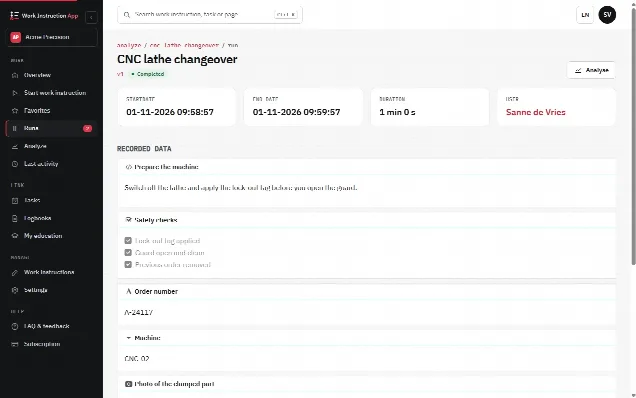
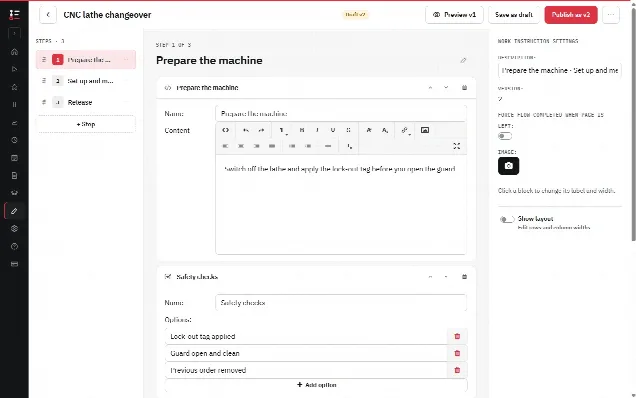
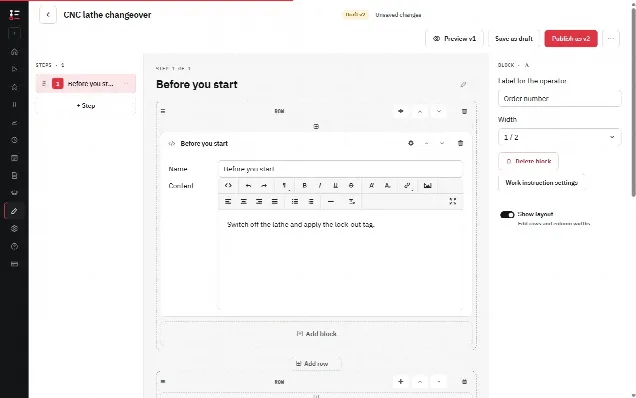
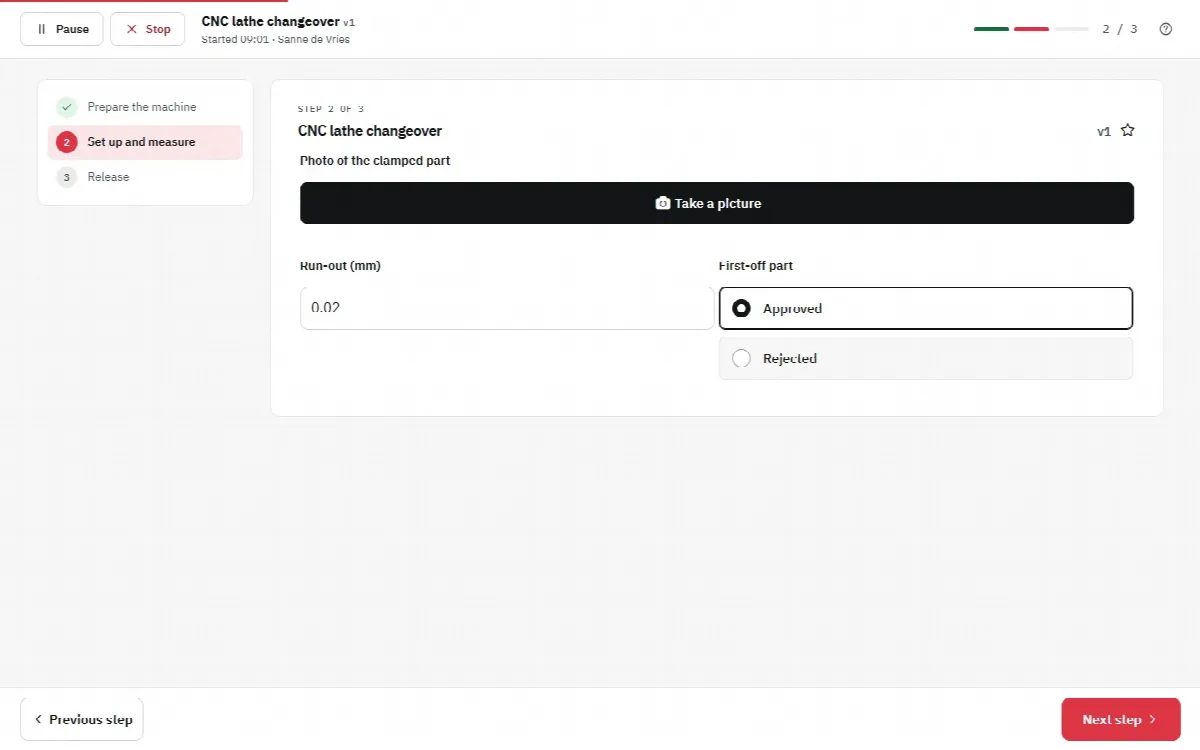
With the Work Instruction App you make the lowest level digital. You build a work instruction in the browser from pages with text, photos, video, PDFs, checkboxes and measurement fields, and mark the checks that are required. An SOP that exists as a PDF can be added to the instruction as a PDF step, so the link between procedure and task stays visible. Publishing creates a new version; older versions stay traceable. Operators start the instruction by scanning a QR code or NFC tag, and every run records the user, the times, the version and all answers and photos. That takes care of the record the SOP asks for.