In short: lockout/tagout (LOTO) is the procedure that makes a machine safe before maintenance or cleaning: you shut it down, isolate every energy source, put a personal lock and a tag on each isolation point, release stored energy and verify that the machine really is at zero energy before anyone starts work. A good LOTO procedure is written per machine, names every isolation point and is followed in the same order every time. A digital work instruction per machine shows each isolation point with a photo and records who locked what, and when.
What is lockout/tagout?
Most serious maintenance accidents do not happen while a machine is running normally. They happen when someone reaches into it while it is supposed to be off: a conveyor that a colleague restarts, a cylinder that still has pressure, a valve that was closed but not locked. Lockout/tagout is the answer to that risk.
- Lockout means placing a lock on an energy isolating device (a main switch, a valve, a breaker) so that it cannot be operated until the lock is removed. Each person working on the machine uses their own lock, with their own key.
- Tagout means attaching a tag to the isolation point that warns not to operate it and says who placed it and why. A tag is a warning, not a physical barrier, so it supports a lock rather than replacing it.
The principle is written down in several places. In the EU, Directive 2009/104/EC on the use of work equipment requires that work equipment is fitted with clearly identifiable means to isolate it from each of its energy sources, and that maintenance is done with the equipment shut down where possible. In the United States, OSHA standard 29 CFR 1910.147 ("The control of hazardous energy") describes an energy control program with machine-specific procedures, training and periodic inspections. In the United Kingdom, HSE guidance HSG253 "The safe isolation of plant and equipment" explains how to choose and secure isolations. For electrical work there are additional rules: in the Netherlands NEN 3140 and NEN-EN 50110, in Germany the five safety rules of DIN VDE 0105-100.
Which energy sources does a LOTO procedure have to cover?
A machine rarely has only one energy source. Missing one is the most common gap in a LOTO procedure: the electrical supply is locked, but the pneumatic supply still holds pressure, or a suspended part can still fall. Go through every type in the table below for each machine.
| Energy type | Examples | Typical isolation | Releasing stored energy and verifying |
|---|---|---|---|
| Electrical | Motors, heaters, control circuits | Lockable main switch or isolator, breaker with lockout device | Discharge capacitors where relevant; test for absence of voltage with a tested meter (by a qualified person) |
| Pneumatic | Cylinders, grippers, air motors | Lockable shut-off valve on the supply | Vent the system through the exhaust valve; check the pressure gauge reads zero |
| Hydraulic | Presses, lifting tables, clamps | Switch off and lock the pump drive, lockable valve | Relieve pressure, take care with accumulators; check the gauge |
| Mechanical (gravity) | Raised rams, lifted tables, counterweights | Lower to the bottom position or block mechanically | Place blocks or safety props; check the part cannot move |
| Mechanical (motion, springs) | Flywheels, tensioned belts, springs | Wait for standstill, lock drives | Release spring tension, wait until everything has stopped |
| Thermal | Ovens, heated moulds, steam lines | Lock the heating supply and the steam valve | Let it cool down; measure the temperature |
| Chemical and process media | Pipes with product, gas, cleaning agents | Close and lock valves; for hazardous substances a positive isolation (blind, spool removed) | Drain, flush or purge; check that the line is empty |
The exact methods for your machines come from the manufacturer's manual and your own risk assessment. The table helps you not to forget a category; it does not tell you how a specific valve or switch must be secured.
Who does what in a lockout/tagout procedure?
Clear roles prevent the most dangerous misunderstanding: assuming that someone else has isolated the machine.
- Authorised person: trained in the LOTO procedure for this machine, applies their own lock and tag and removes only their own lock. In OSHA terms the "authorized employee".
- Affected persons: operators and others who normally use the machine or work in the area. They do not apply locks, but they are informed before shutdown and before restart, and they never try to start a locked machine.
- Supervisor or permit issuer: makes sure the procedure exists, is up to date and is followed; in many companies this person also coordinates group lockout and shift changes.
- Group lockout: when several people work on one machine, each person places a personal lock, often on a group lockbox that holds the keys of the isolation locks. Nobody can restart the machine while one personal lock is still in place.
The lockout/tagout procedure, step by step
The order below follows the sequence that OSHA 1910.147 describes and that most company procedures use. Write it out per machine with the actual isolation points.
1. Prepare
Before you touch anything, open the LOTO procedure for this specific machine and identify every energy source and isolation point. Gather the locks, tags, blocks and test equipment you need, and check that your lock and key are your own.
2. Notify affected people
Tell the operators and everyone else in the area that the machine will be shut down and locked out, why and for how long. Nobody should be surprised that the machine stops or be tempted to restart it.
3. Shut down the machine
Stop the machine with its normal controls, in the normal sequence. A controlled stop avoids extra hazards such as a product stuck halfway or a sudden pressure peak.
4. Isolate all energy sources
Operate every isolation device in the procedure: main switch, air valve, hydraulic valve, steam valve, product valves. Isolating means disconnecting the energy at its source; an emergency stop or a control circuit is not an isolation.
5. Apply locks and tags
Place your personal lock and a completed tag on every isolation point, or on the group lockbox if your procedure uses one. The tag states your name, the date and the reason, so that anyone who finds it knows who to ask.
6. Release or restrain stored energy
Release or block any energy that remains after isolation: vent air, relieve hydraulic pressure, lower or block raised parts, release springs, wait for moving parts to stop and hot parts to cool. Stored energy is the part that is most often forgotten, because the machine already looks safe.
7. Verify zero energy
Check that the isolation actually works before you start: try to start the machine with its normal controls (and return them to off afterwards), check the gauges read zero and have a qualified person test electrical parts for absence of voltage. Only verified isolation counts.
8. Carry out the work
Do the maintenance, cleaning or repair while your lock stays in place. If the work continues into the next shift, the transfer of locks follows the procedure, so that the machine is never without the lock of a person who is responsible for it.
9. Remove locks and restore
When the work is finished, remove tools and material, refit guards, check that everyone is clear and tell the affected people that the machine will be restarted. Each person removes only their own lock, after which the energy is restored and the machine is tested in a controlled way.
What makes a LOTO procedure fail in practice?
Most LOTO problems are not about missing locks, but about missing knowledge of the machine:
- A generic procedure. "Switch off and lock the main switch" does not cover the second air supply at the back or the accumulator in the hydraulic unit. Every machine needs its own list of isolation points.
- Isolation points that nobody can find. A valve described as "the valve near the wall" is found by the person who wrote the procedure, not by a contractor on the night shift.
- No verification. Without the attempt to start and the zero-energy check, a wrongly chosen switch goes unnoticed.
- Procedures that are out of date. A machine is modified, a supply is moved, and the procedure still shows the old situation.
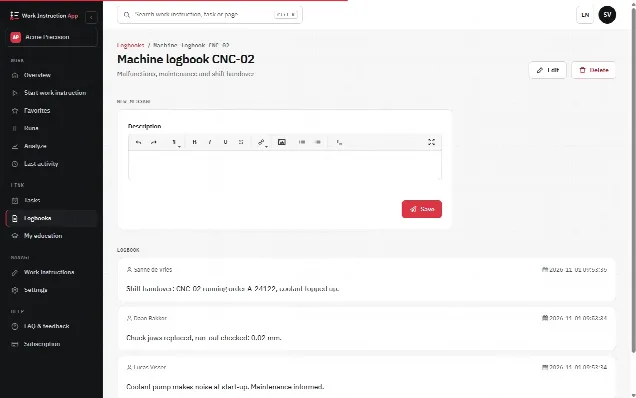
- No record. Afterwards, nobody can say who locked which point, when it was released, or whether the check was done at all.
OSHA 1910.147 requires a periodic inspection of the energy control procedure at least annually. Whatever your local rules, reviewing each machine procedure once a year and after every modification is good practice.
In practice with digital work instructions
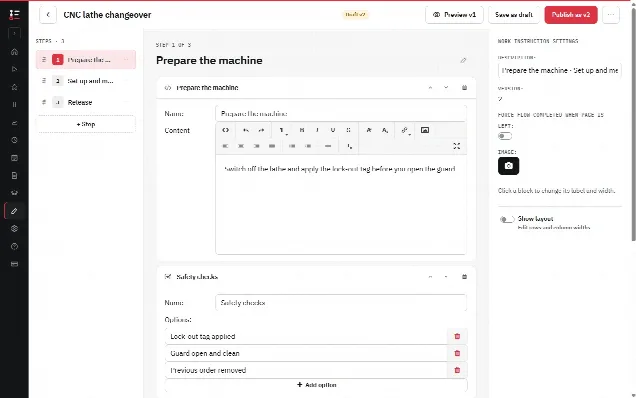
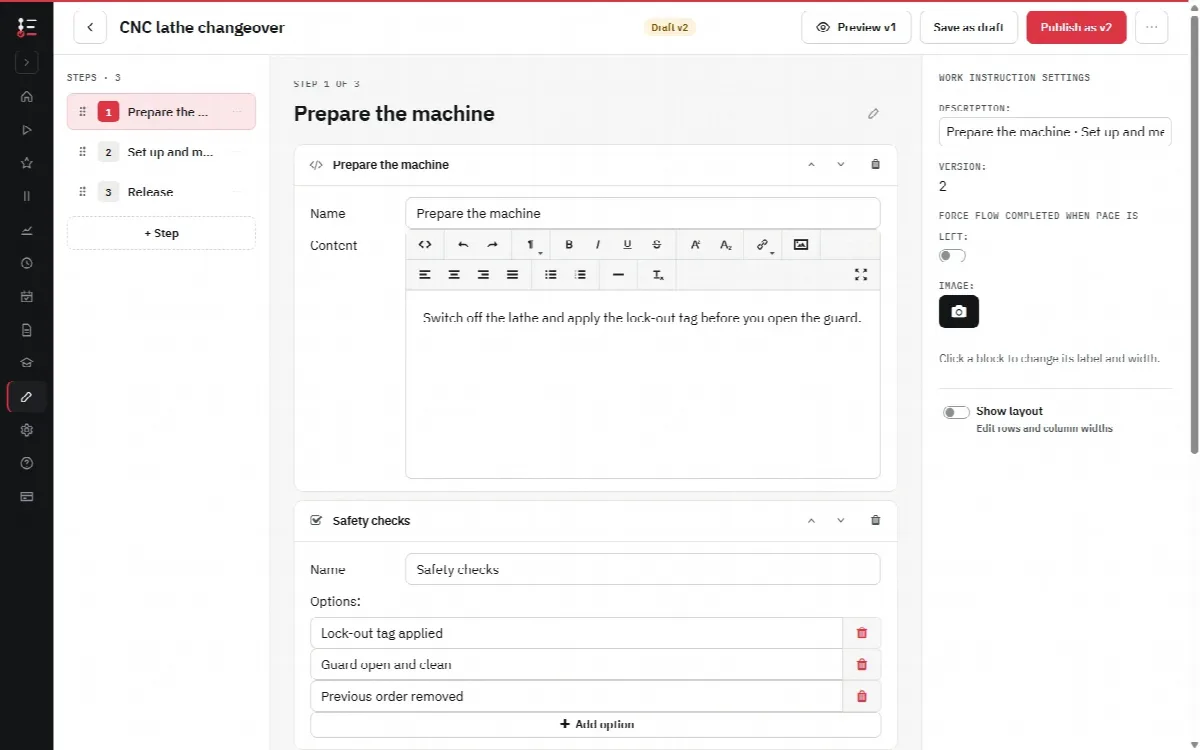
A LOTO procedure is a work instruction in its purest form: a fixed sequence of steps, at a specific machine, where skipping a step is dangerous. In the Work Instruction App you write one work instruction per machine:
- A photo of each isolation point. One step per isolation point, with a photo of the actual switch or valve and its location on the machine. An image of the floor plan with the point marked shows where it is in the hall.
- Required checks per point. For every point a checkbox "isolated", "lock and tag applied" and "zero energy verified", marked as required: Next and Finish only work when they are filled in. A number field records a gauge reading where that helps.
- Start at the machine. A QR code or NFC tag on the machine opens exactly the procedure for that machine, so nobody uses the procedure of the similar press next to it, see work instructions via NFC.
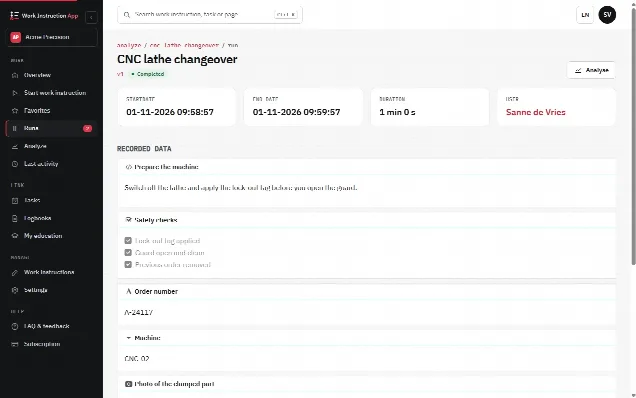
- Signature and record per run. A signature step confirms who carried out the lockout. Each run records the user, start and end time, version and every answer and photo; a run can be paused during the work and resumed afterwards. It reopens at the page where it was paused, with all answers kept, so you continue with the restore steps.
- Version control. After a modification you update the procedure and publish a new version; the earlier runs remain linked to the version that was valid then, see audit trail and inspections.
The app does not replace the physical locks and tags, and it does not decide which isolation is adequate: that comes from your risk assessment and the competent people who write the procedure. What it adds is that the right procedure is at the machine, that every point is visible, and that you can show afterwards that it was followed. For the structure of the steps themselves, see how to write a work instruction; for how this fits into maintenance and production, see work instructions for manufacturing and digital work instructions.