In short: a 5S audit is a short, regular walk through one work area in which an auditor scores each of the five S (sort, set in order, shine, standardise, sustain) against a fixed list of questions. With a 0 to 4 score per question, a photo per area and the same checklist every time, you see where the area slips and whether it improves. Run the audit as a digital work instruction and every result is stored with the date, the auditor and the photos.
What are the five S?
5S is a method for organising a workplace so that everything needed is at hand, everything else is gone, and deviations are visible at a glance. The names come from five Japanese words. In English they are usually translated as five words starting with S; Dutch and German teams use their own S words as well.
| S | Japanese | Dutch | German | What it means |
|---|---|---|---|---|
| 1. Sort | Seiri | Scheiden | Sortieren | Remove everything that is not needed for the work in this area. |
| 2. Set in order | Seiton | Schikken | Setzen (Systematisieren) | Give every item a fixed, marked place close to where it is used. |
| 3. Shine | Seiso | Schoonmaken | Säubern | Clean the area and the equipment, and use cleaning as inspection. |
| 4. Standardise | Seiketsu | Standaardiseren | Standardisieren | Make the first three S repeatable with rules, labels, photos and schedules. |
| 5. Sustain | Shitsuke | Standhouden | Selbstdisziplin | Keep the standard alive through habits, audits and leadership attention. |
The first three S change the workplace. The last two make sure the change is still there in six months. A 5S audit is the main tool for the last two: it checks the standard and makes slipping visible before it becomes the new normal.
How does a 5S audit work?
A 5S audit is not a cleaning inspection. It checks whether the area meets the standard the team agreed on, and whether that standard still makes sense. Three choices determine how useful it is.
- Scoring per S. The auditor answers a small number of questions per S, typically three to five, each on the same scale. Scoring per S shows where the problem is: an area can be spotless (shine) and still have no marked places (set in order).
- Frequency. A short self-audit by the team every week keeps attention on the standard. A formal audit by someone from outside the area once a month gives an independent view. New areas, or areas with a low score, are audited more often.
- Who audits. The best auditor knows 5S but does not work in the area every day: a team leader from another line, a quality engineer, a manager during a shop floor walk. Rotating auditors spreads knowledge of the standard and prevents the audit from becoming a routine tick list.
Always audit the same area with the same checklist. Only then can you compare scores over time. Change the checklist when the standard changes, and note from which date the new version applies.
What score scale should you use?
A scale from 0 to 4 is simple enough to apply quickly and detailed enough to show progress. Describe each level so that two auditors give the same score for the same situation.
| Score | Meaning | Typical observation |
|---|---|---|
| 0 | Not in place | No standard exists, or nobody follows it. |
| 1 | Started | Some items are in order, many deviations remain. |
| 2 | Partly met | The standard exists and is mostly followed, with several deviations. |
| 3 | Met | The standard is followed; at most one minor deviation. |
| 4 | Exemplary | The standard is followed and the team improves it on its own initiative. |
The 5S audit checklist
Use the questions below as a starting point and adapt them to your area. A machining cell, a warehouse aisle and an office need different details, but the structure stays the same.
| S | Question | Score 0-4 |
|---|---|---|
| Sort | Are only the tools, materials and documents present that are needed for current work? | |
| Sort | Are broken, obsolete or unused items removed or marked with a red tag? | |
| Sort | Are there no personal items or stock above the agreed quantity at the workstation? | |
| Set in order | Does every tool and item have a marked, fixed place (shadow board, label, floor marking)? | |
| Set in order | Is every item in its place right now? | |
| Set in order | Are walkways, emergency exits, fire extinguishers and first aid kits free and marked? | |
| Shine | Are floor, machines and workbenches clean, free of oil, chips and waste? | |
| Shine | Are leaks, damage and loose parts found during cleaning reported? | |
| Shine | Are cleaning materials available and in their marked place? | |
| Standardise | Is there a visible standard for the area (photo of the target state, cleaning schedule)? | |
| Standardise | Are labels, colours and floor markings the same as in other areas? | |
| Standardise | Are the current work instructions available at the workstation? | |
| Sustain | Were the previous audit actions completed on time? | |
| Sustain | Was the weekly self-check done and recorded? | |
| Sustain | Can team members explain the standard and why it matters? |
Fifteen questions take an experienced auditor ten to fifteen minutes per area. Keep the list short: an audit that takes an hour will not be done every month.
How do you run a 5S audit step by step?
1. Define the areas and the auditors
Split the site into areas with a clear boundary and a responsible team leader. Each area gets its own audit, so the result says something about a team that can act on it. Draw up a schedule with the auditor and the week for each area.
2. Agree on the standard before the first audit
Take a photo of every area in its target state and agree with the team what "in order" means. Without a shared picture of the standard, the audit becomes a discussion about taste. Put the photo in the checklist so the auditor compares against the same picture.
3. Walk the area at an unannounced moment
Audit during normal work, not right after a cleaning round. An announced audit measures how well the team prepares, not how well the standard holds. Take the checklist and walk the area in a fixed route so you do not skip a corner.
4. Score each question and take photos
Give every question a score from 0 to 4 using the agreed definitions. Take a photo of the area as a whole and of every deviation that lowers a score. A photo prevents discussions afterwards and shows the team exactly what was seen.
5. Record findings and agree on actions
For every score below 3, write down what is wrong, who will fix it and by when. Keep actions small and concrete: "add shadow board for the torque wrenches", not "improve tool storage".
6. Discuss the result with the team on the spot
Share the score and the photos with the team leader before you leave the area. A result that arrives a week later by e-mail has lost most of its effect. Start with what goes well, then go through the actions.
7. Compare results over time and close the actions
Look at the trend per area and per S over several audits. A falling score for sustain while the other S remain stable usually means the self-check has stopped. Check at the next audit whether the actions are closed; that is the first question under sustain.
How do you make the 5S audit digital?
A paper checklist works, but the results end up in a folder and comparing audits means retyping them into a spreadsheet. As a digital checklist the audit is done on a phone or tablet in the area itself, and every answer is stored with the run. A practical structure:
- One step per S. Five steps, each with the three to five questions of that S. The auditor sees one S at a time and cannot lose track.
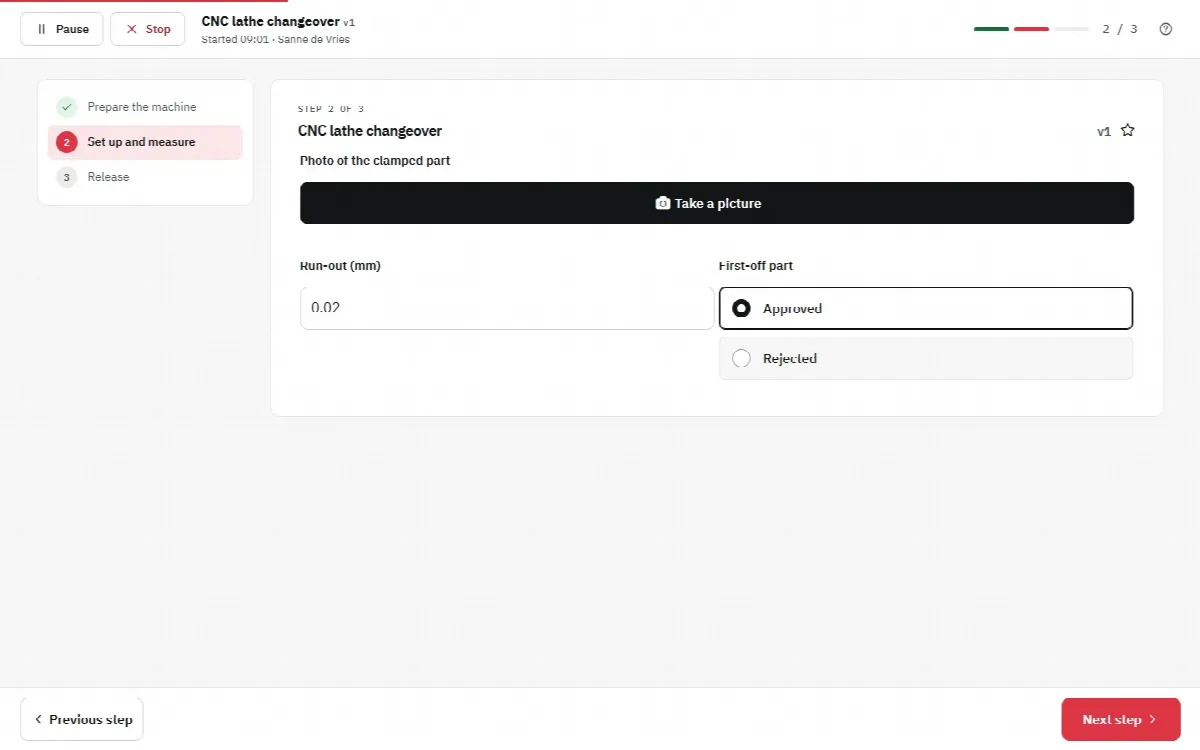
- A radio button per question. A radio button with the options 0 to 4 gives every question the same scale. A slider from 0 to 4 also works, but a slider cannot be marked as required. Put the meaning of the scores in an explanation text block at the top of the step.
- A photo per area. A photo block in each step, so the auditor takes a picture of the state of the area for that S. An image block next to it shows the target state as reference.
- Required fields. Mark the score questions and the photo as Required. The audit cannot be completed with a skipped question, so every result is complete.
- A text area for findings. One text area at the end for deviations and agreed actions, and a signature block for the auditor if your quality system asks for it.
In practice with digital work instructions
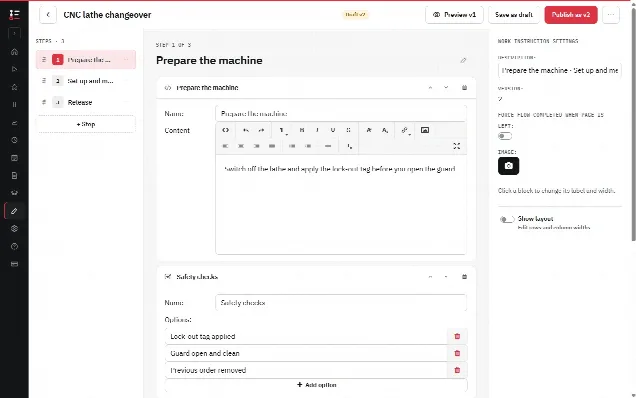
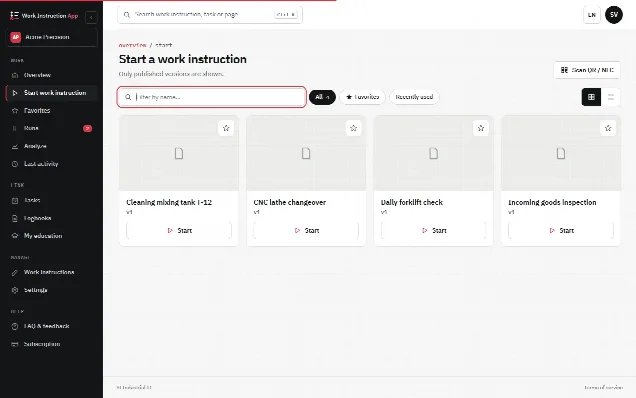
In the Work Instruction App you build the audit in the browser editor as a work instruction with the blocks described above, and publish it. Each area gets a QR code or NFC tag at the entrance; the auditor scans it and the right audit opens. Give each area its own copy of the audit, so its runs form the history of that area. If you prefer one audit for all areas, start it with a selection block for the area; the search in answers (at least three characters) then finds the audits of one area by its name.
Every completed run records the auditor, start and end time, the version of the checklist and every score and photo. In the list of completed runs you filter per work instruction, per user and per period, so the audits of one area over the last months are side by side. When you change the checklist, publishing creates a new version and older audits remain linked to the version they were done with. That is the audit trail an external auditor asks for.
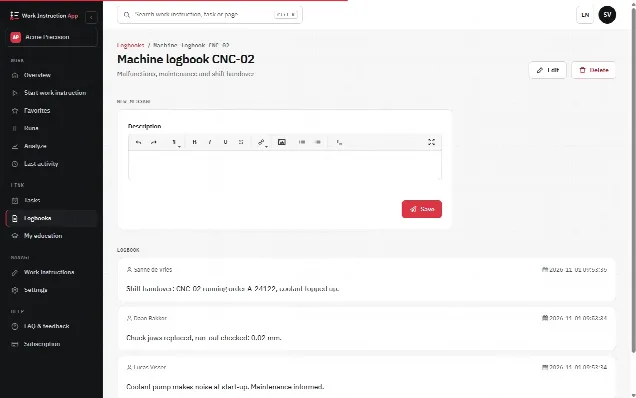
Findings that need follow-up by several people can go into a logbook for the area or machine, where the team adds messages until the action is closed. For the general approach to building instructions, see how to write a work instruction.
How do you keep sustain alive?
Most 5S programmes do not fail on the first three S. They fail when the attention moves elsewhere and nobody notices the slow return of clutter. These habits keep sustain alive:
- Audit on a fixed rhythm. Put the audits in the schedule and treat a missed audit as a finding in itself.
- Make results visible. Show the latest score and photos of each area on the team board. A team that sees its own trend acts on it.
- Close the loop on actions. An action that stays open for months tells the team that the audit does not matter.
- Let the team audit itself. The weekly self-check with the same checklist makes the standard the team's own, not the auditor's.
- Update the standard. When the work changes, update the photo of the target state and the checklist. A standard that no longer fits the work is ignored.
- Leaders walk the floor. A manager who regularly does an audit, asks questions and helps remove obstacles shows that 5S is part of the job.
5S is the base for standard work in manufacturing: a workplace in order makes the steps in a work instruction easier to follow and deviations easier to see. A digital audit makes the result measurable, so the conversation is about the trend rather than about opinions.