In short: standard work is the current best way to do a job at a station, written down so that everyone does it the same way. In lean it has three elements: takt time (the pace the customer needs), the work sequence (the order of the operator's actions) and standard work in process (the minimum material at the station). It is not a fixed rule but a baseline: when the team finds a better way, the standard changes and becomes the new baseline.
What is standard work?
Standard work is one of the foundations of lean manufacturing and of the Toyota Production System it came from. The idea is simple: for every repetitive job there is a best way known today, and that way is written down and followed by everyone who does the job. When three operators on three shifts do the same task in three different ways, you get three levels of quality, three cycle times and no way to tell which method is best.
Standard work solves two problems at once. It makes the result predictable, because the method no longer depends on who is on shift. And it makes improvement possible, because a change can be compared with a known baseline. The often-quoted lean principle is that without a standard there can be no improvement: if nobody knows what the normal way is, nobody can say whether a new way is better.
A common misunderstanding is that standard work means rigid rules imposed from above. In good lean practice it is the opposite. The people who do the work help write the standard, and they are expected to challenge it.
What are the three elements of standard work?
Classic standard work describes a station or a line with three elements. Each answers a different question.
| Element | Question it answers | Example |
|---|---|---|
| Takt time | At what pace must we produce to meet customer demand? | Available time per shift 27,000 seconds, demand 450 units per shift: takt time 60 seconds per unit. |
| Work sequence | In which order does the operator do the actions, and how long does each take? | 1. Take housing from the rack (4 s). 2. Place in fixture (3 s). 3. Insert four screws (18 s). 4. Tighten with the torque driver (12 s). 5. Check and place on the conveyor (6 s). Total 43 seconds, within takt. |
| Standard work in process | How much material must be at the station for the work to flow without waiting? | One housing in the fixture, one finished unit on the conveyor, one bin of screws within reach. No stacks of half-finished units. |
Takt time is calculated, not measured: it is the available production time divided by the customer demand in that period. Cycle time is what the work actually takes. If the cycle time of a station is longer than takt, the line cannot keep up; if it is much shorter, there is room to combine work. The work sequence is where the operator's knowledge lives: the order in which actions are done often matters as much as the actions themselves. Standard work in process prevents both starvation (waiting for parts) and overproduction (piles in front of the next station).
How is standard work different from a work instruction or an SOP?
The three terms are often used as synonyms, but they describe different levels. The table below shows the difference in focus.
| Aspect | Standard work | Work instruction | SOP |
|---|---|---|---|
| Main question | Which sequence, at what pace, with how much material? | How do I do this step correctly? | Which process do we follow, and who is responsible? |
| Main reader | Team leader, engineer, improvement team | Operator at the station | Everyone involved in the process, auditor |
| Level of detail | Actions and times per station | Every step with key points, photos and checks | Process steps, roles, records |
| Typical trigger for a change | New takt, line balancing, kaizen | Better method, complaint, new part | Process or regulation change |
In practice they fit together. The SOP describes the process at a higher level, the standard work defines the sequence and timing per station, and the work instruction shows the operator each step with its key points. Many plants keep the standard work as a sheet for the team leader and use the work instruction as the version the operator actually sees. What matters is that both describe the same sequence.
How do you write standard work for a station?
Writing standard work is mostly observing. The steps below work for most assembly and machine stations.
- Calculate the takt time. Take the available working time per shift (excluding breaks and planned stops) and divide it by the customer demand per shift. This is the pace the station has to support.
- Observe the job several times. Watch experienced operators do the job over several cycles and, if possible, on different shifts. Write down every action and time it with a stopwatch. Note where people differ.
- Choose the best current sequence. Together with the operators, pick the order and method that gives the best result with the least effort and waiting. Remove steps that add nothing, such as searching or walking for tools.
- Define the standard work in process. Decide how many parts, in which position, must be at the station for the work to flow. Mark the places, for example with floor or table markings.
- Add the key points. For each step, write down what makes it right: the torque, the orientation, the visual check. These key points are what turns a sequence into a usable work instruction.
- Try it and adjust. Let an operator work to the new standard for a few shifts, check the cycle time against takt and adjust what does not work in practice.
- Publish it at the station. Make the standard visible where the work is done, with a version and a date, and train everyone who works at the station.
Our guide on how to write a work instruction goes deeper into step 5 and 7: how to phrase steps, where to use photos and how to test an instruction with a new operator.
How do you keep standard work alive?
A standard that hangs on the wall but is no longer followed is worse than no standard, because it gives a false sense of control. Keeping standard work alive is a cycle with three parts:
- Observation. Team leaders regularly watch the job being done and compare it with the standard. Deviations are not a reason to blame the operator but a question: is the standard wrong, unclear or unknown?
- Improvement. When operators find a better way, or when a deviation shows that the standard does not work, the team tests the improvement. A change in takt time (more or less demand) is also a reason to rebalance the work.
- New version. Once the improvement works, the standard is updated, everyone is told what changed and the old version is withdrawn. Only one version may be in use at the station.
The last part is where paper usually fails. Printed sheets are copied, stay behind in drawers and are replaced on one line but not on the other. Version control makes sure every operator sees the current standard, and that you can still see later which version was in use on a certain day.
What is leader standard work?
Leader standard work applies the same idea to team leaders, supervisors and managers. Instead of reacting to whatever comes up, they follow a fixed routine: for example a daily walk along the line at set times, a check of a few stations against their standard work, a short team meeting about problems and a weekly check of the improvement actions. The purpose is not control for its own sake. Shop-floor standards only stay alive if someone looks after them, and leader standard work makes that looking-after part of the job instead of something done when there is time left.
Standard work in practice with digital work instructions
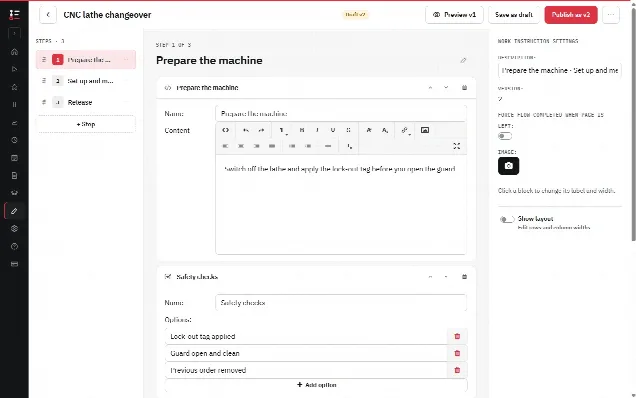
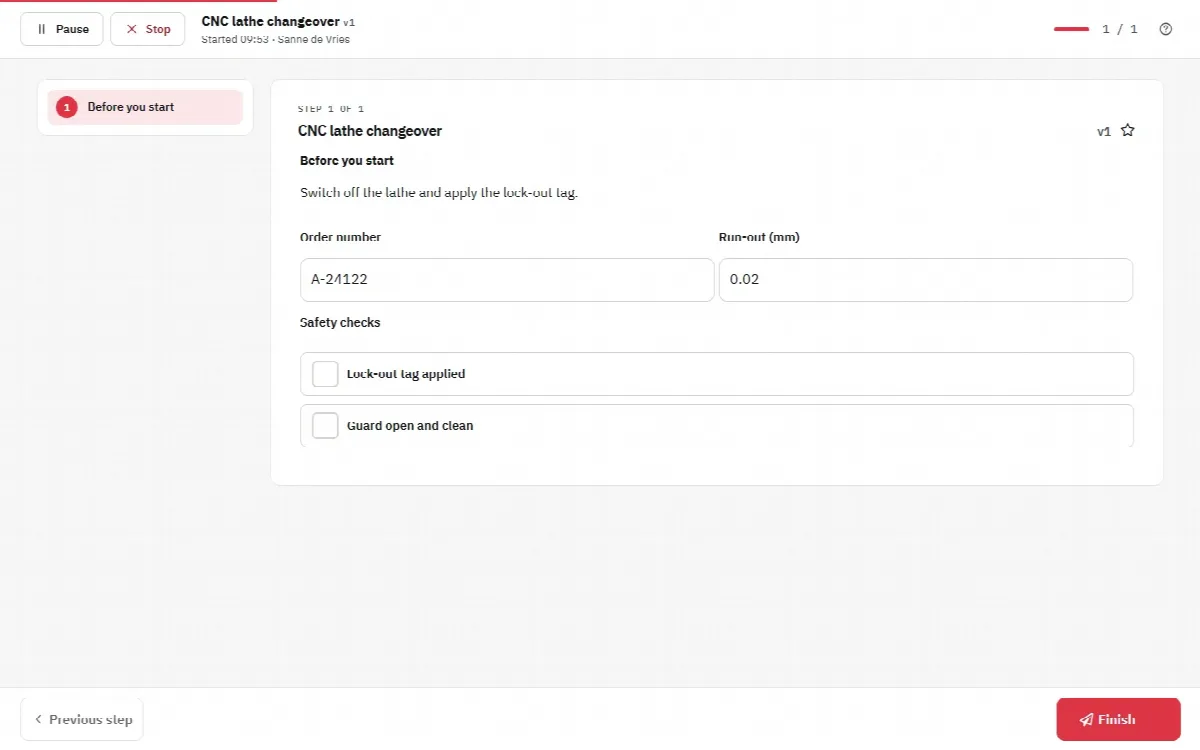
The Work Instruction App does not calculate takt times or balance lines, but it is a practical way to bring the work sequence and the key points to the station. You build the sequence as steps in the browser editor, one action per step, with a photo or short video of the correct result and the key points as text. Checks that must not be skipped become a checkbox or number field marked as Required, so Next only works when it has been filled in.
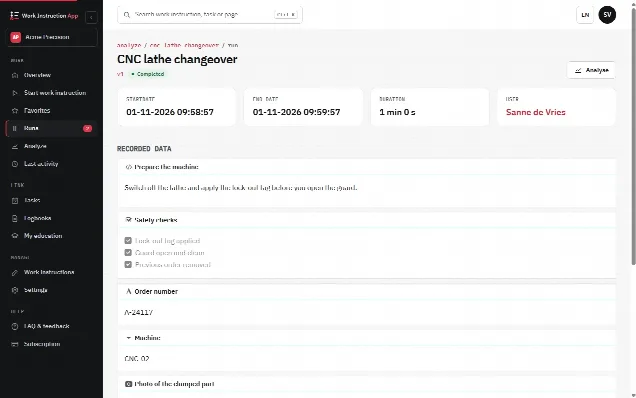
Operators start the instruction at the station from the overview or by scanning a QR code or NFC tag. Every run records who did it, the start and end time, the duration and the version used, so a team leader can open completed runs per work instruction, user and period during an observation round.
When the standard improves, you edit the draft and Publish it as a new version (v1, v2 and so on). From that moment everyone runs the new version, and older versions stay traceable. That is exactly the cycle of observation, improvement and new version that keeps standard work alive. See how this works for production teams on the manufacturing page.
Where should you start?
Pick one station where results vary between shifts or operators. Calculate its takt time, observe the job a few times with the people who do it and agree on one sequence with its key points. Put it at the station as a versioned work instruction, check after two weeks whether it is followed and what should be better, and publish the next version. One living standard teaches a team more about standard work than a folder full of sheets nobody uses.